Building an Internal ChatGPT-like Tool for Enterprise-wide AI Access
grab · Tech · 2025 · source Agentic: no · promotional bias: low · source-backed · extracted with prompt 0.5.4 (schema v2)
Generated from extraction.json — do not edit by hand. Every claim cites verbatim source evidence; stated means the quote directly asserts the claim, implied means it supports it indirectly.
Problem
Domain: Company-wide LLM access platform
Grab needed an internal ChatGPT-like tool that could give employees broad LLM access while satisfying enterprise constraints around security, regional access, provider flexibility, and governance.
Constraints:
- External ChatGPT was inaccessible in some operating regions.
- Sensitive company data could not leave Grab infrastructure.
- Employees needed a simple general-purpose interface rather than a brittle documentation bot.
- Governance teams needed auditable usage.
Architecture
GrabGPT is a company-wide internal ChatGPT-like product layered on Grab's Catwalk model-serving platform. It authenticates employees, routes requests privately to multiple LLM providers, keeps sensitive data within Grab's infrastructure, and preserves an auditable record of interactions.
Diagram confidence: reconstructed (reconstructed from prose).
flowchart LR
  employee[Employee] --> grabgpt[GrabGPT]
  grabgpt --> catwalk[Catwalk]
  catwalk --> llm-providers[LLM Providers]
  grabgpt --> audit-layer[Audit Layer]
Components
| Component | Role | Interacts with |
|---|---|---|
Employee |
Grabber using general-purpose LLM assistance. | GrabGPT |
GrabGPT |
Internal ChatGPT-like tool. | Catwalk, Audit Layer |
Catwalk |
Existing model-serving platform for routing model calls. | LLM Providers |
LLM Providers |
OpenAI, Claude, Gemini, and other supported models. | Catwalk |
Audit Layer |
Records interactions for security and governance teams. | GrabGPT |
Data flow
A Grab employee uses GrabGPT through authenticated internal access. GrabGPT routes the request to Catwalk, which invokes supported model providers such as OpenAI, Claude, or Gemini, then records the interaction for auditability.
Why this architecture
The architecture favored broad employee utility over a narrowly scoped bot. Reusing Catwalk gave the team model-serving leverage, while private routing, model agnosticism, and auditability addressed the enterprise reasons employees could not simply use public ChatGPT.
Models used: OpenAI · Claude · Gemini · GPT-3.5-turbo
Scale
- GrabGPT registered 300 users on its first day.“* Day 1: 300 users registered. * Day 2: 600 new users. * Week 1: 900 new users * Month 3: Over 3000 users, with 600 daily active users * Today: Almost all Grabbers are using GrabGPT.”article, stated
- It reached over 3000 users and 600 daily active users by month 3.“* Month 3: Over 3000 users, with 600 daily active users * Today: Almost all Grabbers are using GrabGPT.
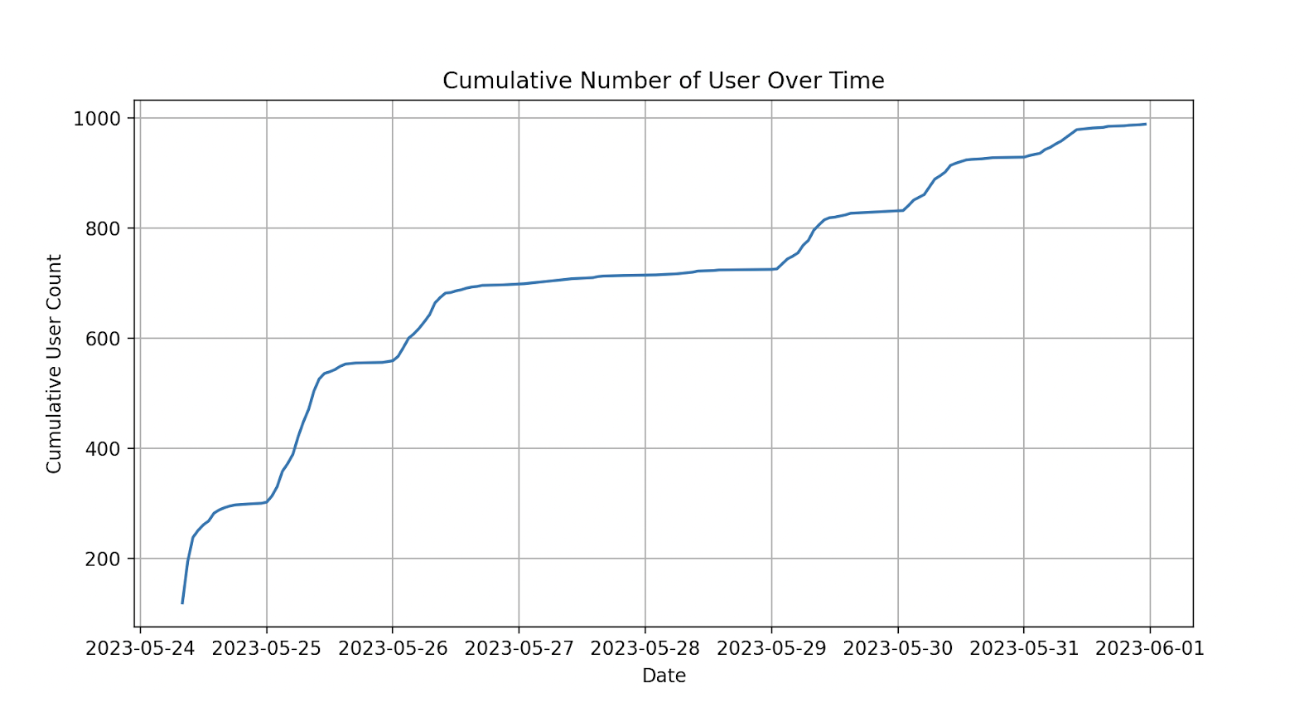 ”article, stated
- Almost all Grabbers were using GrabGPT by the time of the article.“* Today: Almost all Grabbers are using GrabGPT. Figure 1: Number of GrabGPT users in one month”article, stated
Alternatives considered (roads not taken)
Keep working on a support-channel documentation chatbot.
Rejected because: The context limit and embedding-search results made that idea unscalable.
Let employees use public ChatGPT.
Rejected because: ChatGPT was banned in some regions and did not meet Grab's private-routing needs.
Build a tool tied to one model provider.
Rejected because: GrabGPT's value included provider flexibility.
Patterns
model-routing (enterprise AI)
GrabGPT supports multiple LLM providers behind one internal interface.
privacy-preserving-processing (security)
The product uses private routing so sensitive company data stays inside infrastructure.
observability-tracing (governance)
Interactions are auditable for governance.
Tradeoffs
Audience
Chose All-employee internal AI tool over ML Platform support-only chatbot.
Rationale: The failed narrow bot revealed a larger unsatisfied need.
Infrastructure reuse
Chose Existing Catwalk model-serving platform over Building new serving infrastructure for GrabGPT.
Rationale: Catwalk already gave the engineer access to model serving.
Governance
Chose Auditable private internal access over Untracked public-chatbot usage.
Rationale: Security and governance mattered to enterprise adoption.
Gotchas (what bit them)
Context compression can make a documentation chatbot brittle.
Root cause: The team had to reduce documentation to less than 800 words to fit GPT-3.5-turbo.
Resolution: Abandon the narrow bot and build a broader internal ChatGPT tool.
Regional access can be a product requirement.
Root cause: ChatGPT was inaccessible in some countries where Grab employees worked.
Resolution: Provide a company-owned internal interface accessible to Grabbers regardless of location.
Evaluation
Grab assessed the tool through user registration, daily active users, near-company-wide adoption, and enterprise fit across timing, security, accessibility, model agnosticism, and auditability.
Metrics: Registered users · Daily active users · Model-provider coverage · Auditability · Accessibility
Outcomes
- GrabGPT became a company-wide tool after a weekend-project start.
- It reached over 3000 users and 600 DAU within three months.
- It provided private, model-agnostic, auditable AI access to Grab employees.
The source reports 300 day-one users, 600 new day-two users, 900 new week-one users, over 3000 users and 600 DAU by month 3, and near-company-wide usage.