Building Production-Scale AI Search with Knowledge Graphs, MCP, and DSPy
dropbox · Tech · 2026 · source Agentic: yes · promotional bias: low · source-backed · extracted with prompt 0.5.5 (schema v2)
Generated from extraction.json — do not edit by hand. Every claim cites verbatim source evidence; stated means the quote directly asserts the claim, implied means it supports it indirectly.
Problem
Domain: Enterprise AI search and agent context over fragmented work content
Dropbox needed Dash to search, answer, and run agentic queries over proprietary work content scattered across many SaaS applications, while staying fast, ACL-compliant, relevant, and practical within LLM context-window limits.
Constraints:
- Work content lives in third-party SaaS walled gardens rather than in public model pretraining data.
- Connectors must handle each application's rate limits, API quirks, ACLs, and permissions.
- Content types include documents, images, PDFs, audio, and videos with different understanding requirements.
- Federated retrieval is easy to start but inherits variable API speed, ranking quality, and limited shared-content access.
- MCP tool definitions and retrieval results can consume too much context window space.
- Prompt and judge quality must scale across dozens of prompts and many engineers.
Architecture
Dropbox Dash is built around a context engine. Custom connectors crawl third-party apps, normalize content into formats such as markdown, extract metadata and embeddings, understand multimodal media where needed, model cross-app relationships into graph-derived knowledge bundles, store chunks, embeddings, and contextual graph representations in secure lexical/vector stores, and apply ranking plus ACL personalization. For agents, Dropbox wraps indexes as MCP-style super tools, stores large tool results locally rather than in LLM context, routes complex queries to narrower sub-agents, evaluates retrieval relevancy with LLM judges aligned to humans, and uses DSPy to optimize judge and platform prompts across the Dash stack.
Diagram confidence: reconstructed (reconstructed from prose).
flowchart LR
  work-user[Work user] --> dropbox-dash[Dropbox Dash]
  dropbox-dash --> context-engine[Context engine]
  dropbox-dash --> agentic-query-layer[Agentic query layer]
  third-party-apps[Third-party apps] --> connectors[Connectors]
  connectors --> content-normalization[Content normalization]
  content-normalization --> content-understanding[Content understanding]
  content-understanding --> knowledge-graph-builder[Knowledge graph builder]
  knowledge-graph-builder --> people-model[People model]
  knowledge-graph-builder --> knowledge-bundles[Knowledge bundles]
  content-understanding --> secure-data-stores[Secure data stores]
  knowledge-bundles --> lexical-bm25-index[Lexical BM25 index]
  knowledge-bundles --> vector-store[Vector store]
  secure-data-stores --> lexical-bm25-index
  secure-data-stores --> vector-store
  lexical-bm25-index --> ranking-pipeline[Ranking pipeline]
  vector-store --> ranking-pipeline
  people-model --> ranking-pipeline
  ranking-pipeline --> dropbox-dash
  context-engine --> mcp-super-tool[MCP super tool]
  mcp-super-tool --> lexical-bm25-index
  mcp-super-tool --> vector-store
  mcp-super-tool --> local-tool-result-store[Local tool-result store]
  agentic-query-layer --> mcp-super-tool
  agentic-query-layer --> sub-agent-classifier[Sub-agent classifier]
  sub-agent-classifier --> narrow-sub-agents[Narrow sub-agents]
  ranking-pipeline --> llm-judge[LLM judge]
  human-evaluators[Human evaluators] --> llm-judge
  llm-judge --> dspy-optimizer[DSPy optimizer]
  dspy-optimizer --> prompt-stack[Prompt stack]
  prompt-stack --> agentic-query-layer
Components
| Component | Role | Interacts with |
|---|---|---|
Work user |
Person searching and asking agentic questions across work content. | Dropbox Dash |
Dropbox Dash |
Unified AI search and agent interface for work content across Dropbox and third-party apps. | Work user, Context engine, Agentic query layer |
Third-party apps |
External SaaS systems containing proprietary organizational content and access-control rules. | Connectors |
Connectors |
Custom crawlers and integrations that ingest content while respecting app-specific APIs, rate limits, ACLs, and permissions. | Third-party apps, Content normalization |
Content normalization |
Pipeline that standardizes incoming files into normalized text formats such as markdown. | Connectors, Content understanding |
Content understanding |
Extraction and enrichment layer for titles, metadata, links, embeddings, transcription, and multimodal understanding. | Content normalization, Knowledge graph builder, Secure data stores |
Knowledge graph builder |
Relationship modeling across apps, people, meetings, attachments, transcripts, notes, and projects. | Content understanding, Knowledge bundles, People model |
People model |
Canonical identity layer for resolving people across connected apps. | Knowledge graph builder, Ranking pipeline |
Knowledge bundles |
Asynchronously staged summaries or embeddings of graph relationships sent through the normal index pipeline. | Knowledge graph builder, Lexical BM25 index, Vector store |
Secure data stores |
Storage layer for embeddings, chunks, contextual graph representations, and ACL-aware retrieval inputs. | Content understanding, Lexical BM25 index, Vector store, Ranking pipeline |
Lexical BM25 index |
Lexical retrieval index that Dropbox found very effective with relevant signals. | Secure data stores, Ranking pipeline, MCP super tool |
Vector store |
Dense vector storage supporting semantic retrieval and hybrid search. | Secure data stores, Ranking pipeline, MCP super tool |
Ranking pipeline |
Multiple ranking passes that personalize retrieved results and enforce ACL policy. | Lexical BM25 index, Vector store, People model, Dropbox Dash, LLM judge |
Context engine |
Unified retrieval and context platform made from connectors, understanding, graph bundles, stores, indexes, and ranking. | Dropbox Dash, Agentic query layer, MCP super tool |
Agentic query layer |
Agent platform layer that uses context-engine APIs, tools, and sub-agents to answer work queries. | Dropbox Dash, Context engine, MCP super tool, Sub-agent classifier |
MCP super tool |
Consolidated retrieval tool that wraps the index to reduce MCP tool-definition overhead. | Agentic query layer, Lexical BM25 index, Vector store, Local tool-result store |
Local tool-result store |
Local storage for large tool results that should not be placed directly in the LLM context window. | MCP super tool, Agentic query layer |
Sub-agent classifier |
Classifier that chooses a narrow sub-agent and smaller tool set for complex agentic queries. | Agentic query layer, Narrow sub-agents |
Narrow sub-agents |
Specialized agents with narrower tool sets for complex agentic queries. | Sub-agent classifier, Agentic query layer |
LLM judge |
Relevancy judge scoring retrieved information against queries and human labels. | Ranking pipeline, Human evaluators, DSPy optimizer |
Human evaluators |
Engineers and evaluators who label documents and judge disagreement with the LLM judge. | LLM judge |
DSPy optimizer |
Prompt optimizer used to improve LLM judge and broader Dash prompts against eval outcomes. | LLM judge, Prompt stack |
Prompt stack |
Collection of Dash prompts across ingest, judges, offline evals, and the online agentic platform. | DSPy optimizer, Agentic query layer |
Data flow
Dash ingests content from third-party apps through custom connectors, normalizes files into markdown-like formats, extracts metadata, links, titles, embeddings, and multimodal understanding, then models relationships across meetings, people, documents, transcripts, and projects. Embeddings, chunks, and graph-derived knowledge bundles flow into secure lexical and vector stores. Query-time ranking personalizes and ACL-filters retrieved results. Agentic queries call the context engine through consolidated MCP super tools, keep large tool results out of the LLM context, and route complex tasks to narrower sub-agents. Retrieval quality is measured with human labels, LLM judges, NDCG, prompt tuning, and DSPy optimization.
5 supporting quotes
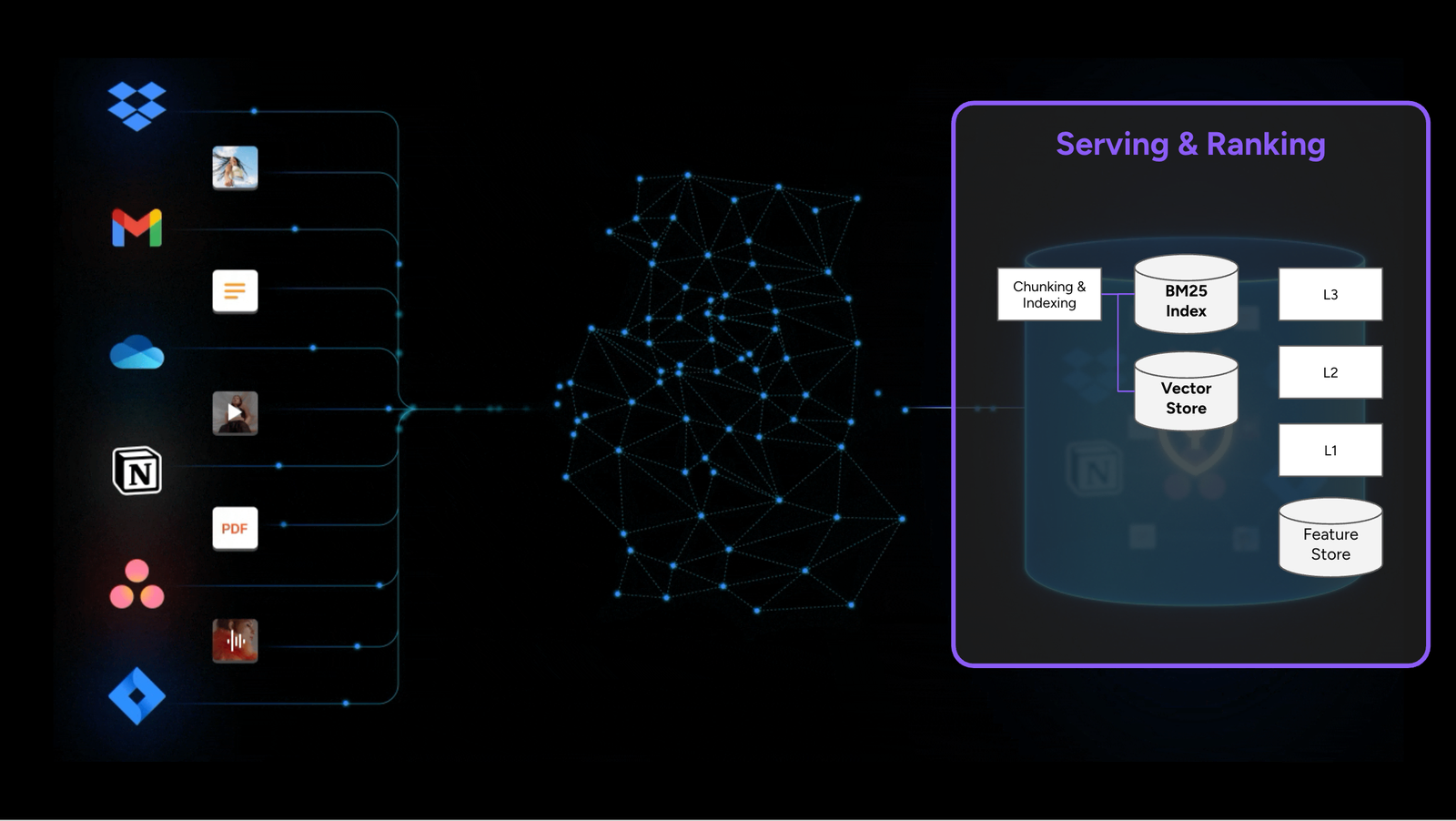 Altogether,”article, stated
Why this architecture
Dropbox chose a heavy index/context-engine architecture because Dash needs company-wide shared content, enrichment at ingestion time, offline ranking experiments, fast query performance, ACL enforcement, graph-derived context, and controllable agent context windows. Federated retrieval was easier to start, but the team judged it too dependent on heterogeneous APIs and too costly in tokens for complex MCP/chatbot usage.
5 supporting quotes
Models used: LLMs · CLIP-based models · Multimodal models · OpenAI o3 · DSPy-optimized models · Planning LLM · Sub-agent models
Scale
- The motivating user context is around 50 open tabs and at least 50 SaaS accounts.“I probably have about 50 tabs open right now—and at least another 50 accounts for other SaaS apps.”article, stated
- Dash caps agent context around 100,000 tokens.“with Dash, we're trying to cap things to about 100,000 tokens.”article, stated
- Simple MCP agent queries can take up to 45 seconds, while raw indexes return content within seconds.“even a simple query can take up to 45 seconds—whereas with the raw index, you're getting all the content coming back very quickly, within seconds.”article, stated
- The super-tool pattern replaces 5-10 retrieval tools with one tool.“instead of 5-10 different retrieval tools, we just have one.”article, stated
- The first LLM-judge prompt had 8% disagreement with human labels.“The first prompt for our judge wasn’t bad—8% disagreed—but the lower, the better.”article, stated
- Dash has over 30 prompts across its stack.“We have over 30 different prompts today throughout the Dash stack”article, stated
- At any time, 5 to 15 engineers may be tweaking prompts.“at any given time we might have 5 to 15 different engineers tweaking these prompts”article, stated
- The described techniques were built over the last few years by a large engineering team.“over the last few years with a big engineering team working on this day-in and day-out.”article, stated
Alternatives considered (roads not taken)
Federated retrieval
Rejected because: It is easy to start and fresh, but depends on varied API speed, quality, ranking, and access limits, and requires heavy query-time post-processing.
3 supporting quotes
Graph database for knowledge graphs
Rejected because: Latency, query patterns, and hybrid retrieval integration were challenging.
Many separate MCP retrieval tools
Rejected because: Tool definitions consume valuable context-window space and degrade chat/agent effectiveness.
Put full tool results into the LLM context
Rejected because: Tool results can be huge, so Dropbox stores them locally and avoids filling the context window.
Manual prompt whack-a-mole
Rejected because: With dozens of prompts and many engineers, hand-editing strings for edge cases breaks at scale.
Patterns
rag-retrieval (context-engineering)
Dash builds a context engine that retrieves proprietary work content and graph context for search, answers, and agentic queries.
Altogether, this is what we call our context engine. And once you have that, you can introduce APIs on top of it and [build entire products like”article, statedhybrid-search (retrieval)
Dropbox combines BM25 lexical retrieval with dense vector storage and hybrid ranking.
retrieval-ranking (retrieval)
The system applies multiple personalized, ACL-aware ranking passes and uses NDCG and judge scores to improve relevance.
llm-as-judge (evaluation)
Dropbox scores retrieved information for relevance with an LLM judge and iteratively reduces disagreement with human labels.
tool-use-orchestration (agent-architecture)
Dash wraps the index as a super tool and uses classifiers/sub-agents to keep each agent's tool set narrow.
context-compaction (context-engineering)
Dropbox reduces context pressure by graph-bundling relationships, consolidating tools, and keeping large tool results out of the LLM context.
eval-driven-development (evaluation)
Human labels, judge disagreement, prompt tuning, model upgrades, and DSPy optimization form a measurement-driven retrieval-improvement loop.
3 supporting quotes
model-routing (model-operations)
The platform expects different planning and sub-agent models, with DSPy helping regenerate prompts for model switching.
Tradeoffs
Choose index-based retrieval
Chose Pre-processing content at ingestion time over Federated query-time retrieval.
Rationale: Indexing is much more work, but it enables company-wide content, enriched datasets, offline ranking experiments, and fast query-time retrieval.
3 supporting quotes
Use BM25 alongside vectors
Chose Lexical BM25 plus dense vector storage over Pure vector-only retrieval.
Rationale: Hybrid retrieval is supported, but Dropbox found BM25 alone highly effective with the right signals.
Represent graph context as knowledge bundles
Chose Asynchronous graph-derived bundles passed through the index pipeline over Serving directly from a graph database.
Rationale: The bundle approach avoided graph database latency and hybrid-query challenges while still adding relationship context.
Consolidate MCP retrieval
Chose One index-backed super tool and narrow sub-agents over Many retrieval tools exposed directly to the LLM.
Rationale: This reduces tool-definition context overhead and gives complex queries a smaller, more relevant tool set.
Let the judge retrieve context too
Chose RAG as a judge over A judge relying only on precomputed or pretrained knowledge.
Rationale: Workplace acronyms and local context may be unknown to the judge, so it sometimes needs retrieval before scoring relevance.
Use DSPy for prompt optimization
Chose Programmatic prompt optimization over evals over Manual prompt-string editing for every edge case and model switch.
Rationale: DSPy improved LLM-judge results, helped manage dozens of prompts, and makes model switching faster.
Gotchas (what bit them)
LLMs cannot answer work questions if proprietary content is outside their reach.
Root cause: Work content is scattered across walled gardens and SaaS applications.
Resolution: Use connectors and a context engine to bring third-party work content into one searchable, ACL-aware place.
Connectors are not commodity plumbing.
Root cause: Every app has its own rate limits, API quirks, ACLs, and permissions.
Resolution: Invest in custom crawlers and connector engineering before relying on downstream retrieval quality.
MCP can rot the context window.
Root cause: Tool definitions and returned retrieval content quickly consume context budget.
Resolution: Cap context, consolidate retrieval into super tools, use graph context, store large tool results locally, and route to narrow sub-agents.
3 supporting quotes
Graph databases were not the practical retrieval substrate.
Root cause: Latency, query patterns, and hybrid retrieval were hard to make work.
Resolution: Build graph relationships asynchronously into knowledge bundles that flow through the same index pipeline.
3 supporting quotes
Human click signals disappear when retrieval serves an LLM instead of a person.
Root cause: Chat systems retrieve context for the model, so humans no longer directly click retrieved documents to indicate relevance.
Resolution: Use LLM-as-judge plus human evaluator labels to score relevancy and train improvement loops.
Prompt editing becomes whack-a-mole at stack scale.
Root cause: Many prompts and many engineers create regressions when edge-case fixes are hardcoded as text strings.
Resolution: Use programmatic prompt optimization with DSPy and eval-defined objectives.
Evaluation
Dropbox evaluates retrieval and agent context quality through NDCG scoring, human document labels, LLM-as-judge relevancy scoring, disagreement analysis, prompt tuning, model upgrades such as OpenAI o3, RAG-assisted judges, and DSPy prompt optimization. Prompt optimizers are especially applied where rubrics and eval outcomes are crisp, such as LLM-as-judge.
Metrics: NDCG · Human/LLM judge disagreement rate · One-to-five relevance scores · Human thumbs up/down feedback · Human evaluator labels · Prompt optimization eval outcomes · Model-upgrade judge agreement · Retrieval recall · Context-window token usage · Query latency
5 supporting quotes
Outcomes
- Dropbox built Dash as a universal work search and agentic-query product over Dropbox and third-party apps.
- Index-based retrieval was judged superior at scale despite large engineering and storage costs.
- BM25 proved highly effective and became a strong indexing workhorse alongside vector storage.
- People modeling and knowledge-graph context produced nice wins in NDCG/relevance.
- Super tools, graph context, local result storage, and sub-agent selection reduced MCP/context-window pressure.
- The first judge prompt had 8% human disagreement, and prompt tuning, o3, RAG-as-judge, and DSPy reduced disagreements further.
- DSPy is being expanded across over 30 Dash prompts spanning ingest, judges, offline evals, and online agentic platform prompts.
The source reports 50+ tabs and 50+ SaaS accounts as the motivating user problem, a roughly 100K-token context cap, simple MCP queries taking up to 45 seconds versus raw index retrieval within seconds, consolidation from 5-10 retrieval tools to one super tool, 8% initial judge disagreement, over 30 prompts, 5-15 engineers editing prompts, and several years of work by a large engineering team.