Context-Driven AI Data Assistant for Enterprise Data Warehousing
spotify · Media & Entertainment · 2026 · source Agentic: yes · promotional bias: low · source-backed · extracted with prompt 0.5.5 (schema v2)
Generated from extraction.json — do not edit by hand. Every claim cites verbatim source evidence; stated means the quote directly asserts the claim, implied means it supports it indirectly.
Problem
Domain: enterprise data access and SQL analytics
Spotify needed a way for thousands of teams to ask data questions across a huge warehouse without waiting on individual domain experts or giving an LLM raw schemas it could misunderstand.
Constraints:
- Spotify's warehouse spans more than 70,000 datasets and petabytes of data.
- Raw schemas do not encode business definitions, legacy quirks, or canonical query patterns.
- Answers had to be transparent and trustworthy enough to influence business decisions.
- The context layer had to stay fresh as schemas and business logic changed.
Architecture
Spotify built Vedder as a ReAct-style data assistant backed by human-owned context clusters. Each cluster contains curated datasets, vetted question-SQL pairs, and business docs. The agent selects an appropriate cluster, generates and executes SQL against the warehouse, returns the answer with query and sources, then logs conversations and health signals back to domain owners for maintenance.
Diagram confidence: explicit (topology described by the source).
flowchart LR
  user-access-surfaces["user access surfaces"] --> vedder-react-data-agent["Vedder ReAct data agent"]
  vedder-react-data-agent --> cluster-context-layer["cluster context layer"]
  cluster-context-layer --> dataset-context["dataset context"]
  cluster-context-layer --> vetted-question-sql-pairs["vetted question-SQL pairs"]
  cluster-context-layer --> business-docs["business docs"]
  vedder-react-data-agent --> data-warehouse-query-tool["data warehouse query tool"]
  vedder-react-data-agent --> conversation-feedback-log["conversation feedback log"]
  conversation-feedback-log --> cluster-owner-dashboard["cluster owner dashboard"]
  conversation-feedback-log --> cluster-health-monitor["cluster health monitor"]
  cluster-health-monitor --> cluster-owner-dashboard
  cluster-owner-dashboard --> cluster-context-layer
Components
| Component | Role | Interacts with |
|---|---|---|
user access surfaces |
Slack bot, MCP server, and web UI where users ask questions and inspect results. | Vedder ReAct data agent |
Vedder ReAct data agent |
Selects context, reasons and acts over tool calls, writes SQL, runs it, and returns answer, query, and sources. | user access surfaces, cluster context layer, data warehouse query tool, conversation feedback log |
cluster context layer |
Domain-owned context package composed of relevant datasets, vetted examples, and docs. | Vedder ReAct data agent, dataset context, vetted question-SQL pairs, business docs, cluster owner dashboard |
dataset context |
Provides relevant tables with schema, profiling, cardinality, common values, and partitions. | cluster context layer |
vetted question-SQL pairs |
Few-shot examples curated or approved by domain experts to teach canonical query patterns. | cluster context layer |
business docs |
Captures terminology, gotchas, definitions, and column-use guidance that schemas do not encode. | cluster context layer |
data warehouse query tool |
Executes generated SQL against Spotify's warehouse. | Vedder ReAct data agent |
conversation feedback log |
Records conversations, SQL, answers, and user feedback for owners to improve clusters. | Vedder ReAct data agent, cluster owner dashboard, cluster health monitor |
cluster health monitor |
Calculates health signals such as data health, pair validity, coverage, and reproducibility. | conversation feedback log, cluster owner dashboard |
cluster owner dashboard |
Shows experts where to spend curation effort and suggested actions when cluster health degrades. | cluster context layer, conversation feedback log, cluster health monitor |
Data flow
A user asks a data question in Slack, an MCP-enabled IDE/tool, or the web UI. Vedder selects the relevant domain cluster, uses curated datasets, examples, and docs to generate SQL, runs the query against the warehouse, returns the answer with sources, and logs questions, SQL, feedback, and health signals to cluster owners.
Why this architecture
Spotify deliberately placed a human-owned context layer between the LLM and the warehouse because the warehouse is too large for raw-schema prompting, and schema alone cannot carry business meaning. Domain experts decide what context is true; the model reasons over that curated context.
Models used: LLM data agent · ReAct reasoning loop
Scale
- Spotify's data assistant operates over more than 70,000 datasets containing petabytes of data.“with over 70,000 datasets at Spotify, amounting to petabytes of data”article, stated
- Spotify's data platform processes 1.4 trillion data points daily.“Spotify's data platform processes 1.4 trillion data points daily across 70,000+ datasets.”article, stated
- Since August 2025, Vedder has been used by more than 2,100 Spotifiers.“It has been actively utilized since August 2025 by over 2,100 Spotifiers”article, stated
- The assistant has handled more than 13,000 conversations and 60,000 messages.“within 13,000+ conversations, and 60,000+ messages using 177 clusters”article, stated
- Vedder's context layer currently covers 177 clusters across many business domains.“using 177 clusters covering advertising, podcasts, music, audiobooks, finances, creators' tools, and more than a dozen other fields.”article, stated
- Only 12.5% of automatically proposed question-SQL pairs were accepted by curators.“They accepted only 12.5% of the proposed pairs.”article, stated
Alternatives considered (roads not taken)
put all warehouse schemas into the LLM
Rejected because: Context windows cannot fit the full warehouse, and schemas alone miss business semantics and legacy edge cases.
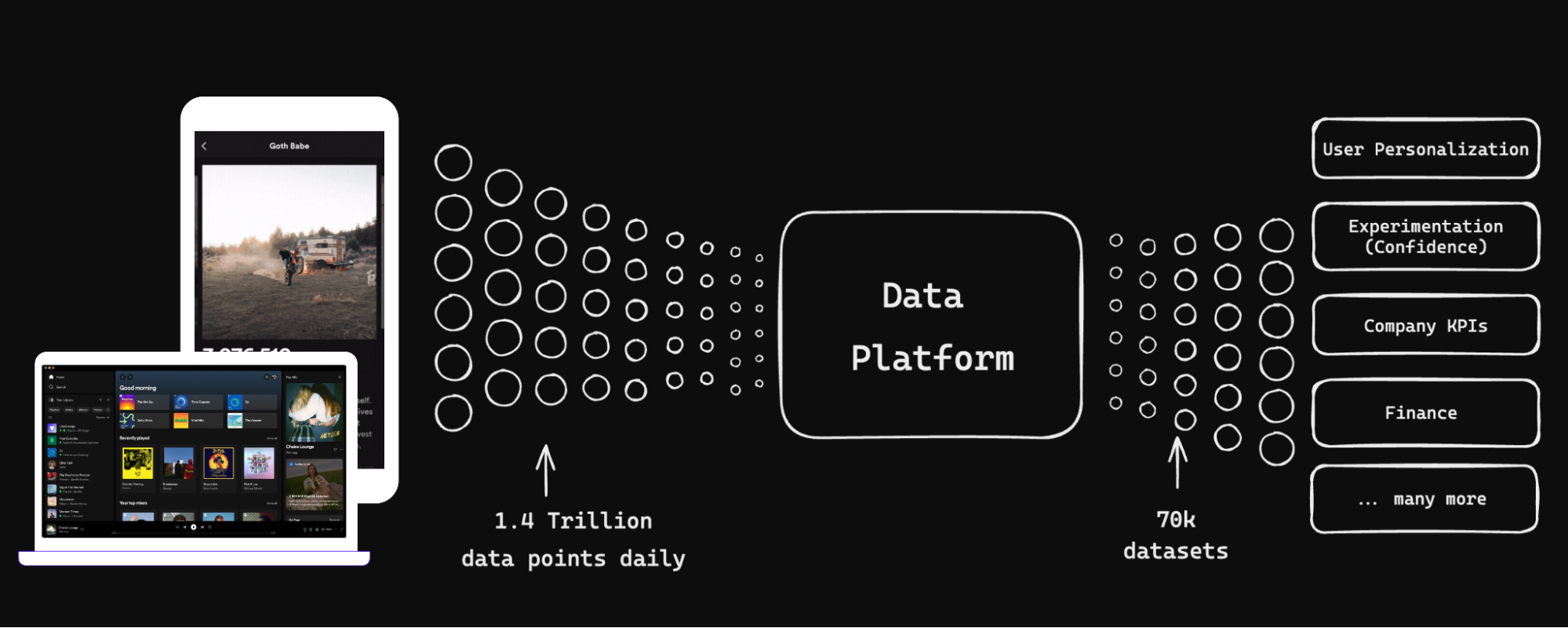 ”article, stated
skip curation and generate examples from query history
Rejected because: Most query-history-derived pairs were noisy, one-off, wrong-table, or poor canonical examples.
continue routing every question to individual Slack experts
Rejected because: Demand from thousands of teams had outpaced what individual experts could handle one request at a time.
Patterns
tool-use-orchestration (agent-architecture)
Vedder uses a ReAct loop to pick context, call tools, write SQL, execute it, and adjust from tool responses.
rag-retrieval (context-management)
The assistant retrieves domain-specific context clusters rather than prompting over the whole warehouse.
human-in-the-loop-gate (governance)
Domain experts curate the context and approve canonical question-SQL examples before they influence the model.
data-quality-loop (operations)
Every Vedder conversation feeds back to cluster owners, and health scores guide ongoing context maintenance.
eval-driven-development (quality)
Cluster health metrics track whether curated examples remain valid, context covers real questions, and generated SQL is reproducible.
Tradeoffs
Put ownership of truth in curated clusters rather than in the model.
Chose domain-expert-owned datasets, examples, and docs over letting the LLM infer truth directly from warehouse schemas.
Rationale: The LLM can reason over context, but experts know which context is correct and canonical.
Require human review of examples despite having complete query history.
Chose curator-approved question-SQL pairs over automatically generated pairs from historical queries.
Rationale: The auto-generated pool was mostly noise, so review cost bought trustworthiness.
Expose answers with query and sources instead of only final results.
Chose transparent answer surface over opaque assistant answers.
Rationale: Users can inspect how the answer was produced, which supports trust in the system.
Gotchas (what bit them)
Raw schemas made the model confidently wrong.
Root cause: Schemas omit semantics such as legacy data ranges, definition differences, and what concepts like active user mean.
Resolution: Use curated docs, dataset profiling, and canonical examples owned by domain experts.
Automatically mined query history looked scalable but mostly produced bad teaching examples.
Root cause: Historical queries include exploration, debugging, one-off answers, wrong tables, and technically correct but misleading patterns.
Resolution: Require domain experts to review and mark examples as canonical.
The context layer can decay as data and business logic change.
Root cause: Schemas evolve, columns are renamed, tables are deprecated, and definitions shift over time.
Resolution: Continuously calculate cluster health and surface degraded context to owners with suggested actions.
Evaluation
Spotify evaluated trust and usefulness through curator acceptance of generated question-SQL pairs, production usage, cluster health scores, reproducibility checks, and user feedback loops.
Metrics: 12.5% curator acceptance rate for proposed pairs · 2,100+ users · 13,000+ conversations · 60,000+ messages · 177 clusters · cluster health signals including pair validity, coverage, and SQL reproducibility
Outcomes
- Spotify launched Vedder across Slack, MCP/IDE tools, and a web UI.
- More than 2,100 Spotifiers used it in 13,000+ conversations and 60,000+ messages.
- The system made domain experts' knowledge reusable through curated clusters rather than one-off support.
Vedder runs over 177 domain clusters in a data environment of 70,000+ datasets and petabytes of data.